


0dls
// key words
spacial dynamics
static education
collectivity
classroom perception
cognitive load
adhd
mental health
human-factors engineering
modularity
me factory
manufacturing
// premise
A friend once called me from the other side of the Atlantic during my first year in the program, early morning his time, still moving through a warehouse after returning from a conference. He said something that stayed with me longer than he probably intended, that he'd met a second billionaire in his life, and there was something different about them, they walked slowly.
For days, that sentence followed me around. I realized I'd had the equation backwards. When I called him again, I said, we're running so that one day we can walk slow, but what if the people we're chasing simply walk through life from the start, and skip the running altogether.
If our bodies really are vehicles carrying us through the world, then the speed at which we move through it must shape how we perceive it. A bee moving past you experiences your stillness as slowness, purely a matter of scale and relative motion. Every species perceives time differently, calibrated to its own pace.
Slowing down became a genuine turning point. For the first time, people on the street began passing me instead of the reverse. I found I could take in roughly twice as much simply by moving half as fast. Things I would have missed entirely became visible, and with that visibility came a deeper sense of appreciation, and gratitude.
On one of those slower walks through a park in London, a group of school-aged children passed by, somewhere between elementary and early adolescence. I let myself really watch them. I have nieces and nephews in that same range, and I found myself wondering what their day-to-day education actually looks like now. What are they being taught, and how.
The honest answer is, not much has structurally changed. Content and delivery have evolved, certainly, but the fundamental dynamics of a classroom, how students engage with each other and with what they're learning, have lagged behind everything else. Adulthood moves at an increasingly relentless pace, and children inherit the consequences of that speed before they're equipped to handle it. Youth mental health is a growing concern precisely because of this mismatch. Our classrooms need to evolve alongside everything else that's changing around them. The children are counting on it, whether we're paying attention or not.
// research


// diversity: Globalization has reshaped the modern classroom into something far more layered than it once was, a genuine convergence of cultures, languages, and lived experiences sitting side by side in the same room. That diversity is an asset, but it's also a design challenge most classrooms weren't built to accommodate, spaces still largely structured around a single, uniform mode of teaching and learning rather than the range of backgrounds actually present in them. Designing for this meant asking what a learning environment would look like if it treated that diversity as a starting point rather than an afterthought.
// ADHD: Remains one of the most common neurodevelopmental conditions of childhood, affecting attention, impulse control, and the ability to stay engaged in traditionally structured settings. Classrooms built around long periods of stillness and passive listening tend to work against how a meaningful percentage of students actually process information, meaning the environment itself can become a barrier rather than a support. This became a central design consideration, not accommodating a minority of students as an exception, but rethinking classroom structure in a way that could genuinely benefit the full range of how children learn.
// vandalism: Sociological research points to a range of motivations behind school vandalism, vindictiveness, ideological expression, acquisitiveness, boredom, or frustration among them. Read together, these motivations point less toward individual misbehavior and more toward a symptom of disengagement, a sign that students don't feel a sense of ownership over, or connection to, the spaces they're required to spend their days in. That reframing became useful, treating vandalism not as a discipline problem to solve after the fact, but as feedback about the environment itself.
// space: Physical space does more than set a mood, it directly affects a student's ability to concentrate and their confidence in engaging with material. Research from MDR Education found that the overwhelming majority of educators, 94%, believe classroom space meaningfully impacts learning outcomes, most notably through its capacity to engage and motivate students. That statistic reinforced a core assumption behind the project, that redesigning the physical classroom wasn't a cosmetic exercise, but a functional one, directly tied to how well students could actually learn.
// cognitive load
Each generation inherits more information than the one before it, a natural consequence of accumulated knowledge compounding over time. Left unaddressed, that growing volume becomes genuinely overwhelming for young learners still developing the capacity to process and retain it, with real consequences if educational environments don't adapt to match the load they're now expected to carry.
// static environments
Today's classrooms are built almost entirely from static elements, fixed chairs, fixed desks, fixed sightlines. Students remain seated for hours at a stretch, expected to absorb new information while their bodies stay motionless. If the furniture doesn't move, the reasoning goes, the student shouldn't either. The result is a room full of still children, in a world that increasingly rewards adaptability, movement, and fast-paced thinking, an environment training students for a version of the world that no longer exists.
// efficiency
I've long been drawn to the aesthetics of electronic circuitry, the choreographed movement of electricity that, only when working collectively, produces real function. A computer is capable of holding and switching between multiple tasks at once, and that idea became a kind of design metaphor, if students could move through information and collaboration with that same fluidity, a genuine paradigm of efficiency might be within reach in the classroom itself.
// environment
Labyrinth mazes became a second point of inspiration, structures that share circuitry's architectural complexity, and that demand real mental effort to navigate. That connection led me toward the idea of cognitive collectiveness, thinking through students, not as isolated individuals processing information alone, but as a connected system moving together, and it raised the question of how genuine motion could exist within a classroom environment that has traditionally been built to stay still.


// process

// me factory
For an early stage of the module, we were asked to propose three directions of interest around sustainable manufacturing. Working from that brief, I set out to merge two of the concepts I'd developed.
// lifetime chair
The first direction was something I called the "lifetime chair." The average adult spends over 18 years of their life sitting down, and there are an estimated 5.7 billion chairs in existence worldwide. I wanted to design a base that could evolve across a person's lifetime rather than being replaced outright, a child's seat that could transition into a desk chair, and eventually into a mobility aid, with individual parts swapped out over time instead of the whole object discarded.
// school chair
The second direction turned toward traditional school furniture. I remember writing that proposal in tears, aware that what I was reaching for mattered more than the assignment itself, it was about the future, about children who needed something better than what they had. That emotional spark became the true starting point for niv 1.0d, driven by a vision of children learning collectively, in a space built to move rather than sit still. Ultimately, I wanted something children could build and reconfigure themselves to suit whatever they were studying, keeping manufacturing minimal while giving schools a stock of modular parts that could adapt endlessly rather than needing constant replacement.
// development
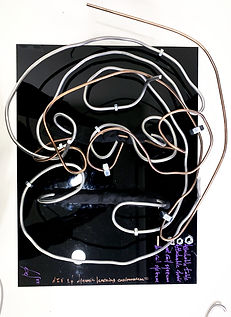
The suggestion to hybridize the two concepts came from a module instructor, and from there I began prototyping small-scale modules to help work through the increasingly complex idea taking shape, what would eventually become 0dls, dynamic learning systems.


// form
Ahead of fabrication, I consulted with a number of industry professionals and ran material testing alongside experienced metalworkers at the Royal College of Art. That process shaped the final material choices, steel bar and sheet stock, custom angle connectors, and copper sheet, representing a meaningful material investment in getting the form right before moving into full assembly.

With the design ready to move into assembly, the next challenge was engineering a bearing system that could support real motion within the environment. I worked with steel bar stock, metal bearings, and standard hardware, bending and cutting the material to form a circular track that gave the piece both its structural function and its aesthetic identity.


// elements
For the design of the surrounding elements, I drew inspiration from space and aerodynamic design, pulling cues from science fiction I'd read and watched over the years exploring space exploration. Combined with the metal components already in play, that influence gave niv 1.0d a distinctly futuristic look and feel.


// fabrication
Once the steel components were cut and bent, I assembled the bearing system and refined the chair and table edges after machining. The workshop was under heavy demand at the time, but having the hardest work already behind me let me keep moving without losing pace. Staying organized and prepared, values that run through everything under the 0d name, made the difference here. The final workshop task was welding the seats to the bearing housing, which I completed with a bit of help once the space opened up.


// assembly
I had three weeks of workshop access total, which left just one week to fully assemble niv 1.0d ahead of the exhibition. From there, it was a matter of transporting the modular parts to the gallery, polishing the piece, and testing the bearings for fit and motion. To my relief, the mechanism moved exactly as intended. The last steps were connecting the angles and attaching the legs, and niv 1.0d was complete.


// outcome

// modularity
To everyone's surprise, including my own, I completed a full-scale model in just a single month. The original brief asked for a single chair, designed around the "me factory" principle. Instead, I built an entire functional environment, modular enough that schools could maintain a stock of parts while students assembled and reconfigured their own dynamic learning spaces to fit whatever they were studying.
// compatibility
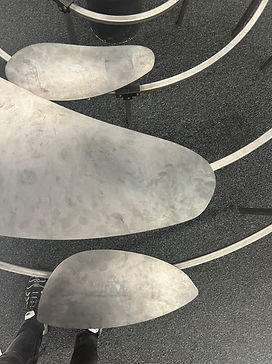
The final piece included one large communal table, a copper-plated table for elevated sketching, and three seats. Scaled appropriately, it could accommodate roughly four children in an elementary or middle school setting, or one to two adults working in a design studio context. The circular motion built into the system was designed to support creative thinking, using physical movement as a quiet driver of classroom engagement
and productivity.



// results
During my undergraduate years, a colleague once reminded me, while I was hanging a piece for critique, that the work in front of us was an intermediate submission, not a final one. I told them I treat every submission as if it were final. That mindset has stayed with me since, it's what pushes me to keep raising the bar rather than settling for what's expected, and it's often where I stand out most, a willingness to do whatever the work actually requires.

// reception
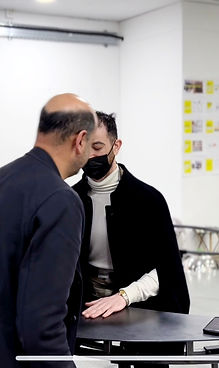
The project drew strong, detailed feedback from faculty and industry reviewers. One instructor called it a well-considered, well-executed project, noting that its real success was in proposing a new form of behavior altogether, using physical movement to reintroduce embodiment into increasingly screen-bound, virtual workflows, while suggesting the structural and sculptural elements still had room to develop into more refined, functional solutions. Another reviewer highlighted the shift from a single chair into a full office concept, praising the engineering and finish while noting the design pushed well past the original brief, and suggested the structure could eventually be anchored more permanently without compromising its form. A third called the ambition of the concept admirable, alongside a memorably bold presentation, while noting the structure would benefit from further resolution given more time. A fourth, the program's head, described it simply as interactive school furniture that created genuine collaborative space, combining strong creative ideas with solid technical execution.


// public engagement
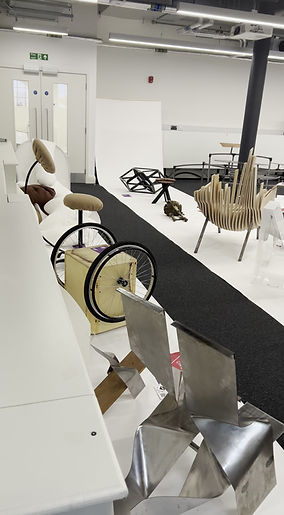
Several months after the original exhibition, niv 1.0d was shown again as part of a large public festival hosted at Imperial College London's design engineering school, drawing an estimated 70,000 to 100,000 visitors, largely families, over the course of the event. It was a rare opportunity to gather genuine public feedback outside an academic setting, children were consistently drawn to it, and parents responded with real curiosity and interest.
// leadership
For that exhibition, I was brought onto a small curation team assembled by the program's department head, where I took on responsibility for the floor plan and overall visitor journey through the space, shaping how the public would encounter and move through the piece.
// evaluation

// human-centric: Classrooms have evolved technologically over the past two decades, but remain visually and socially primitive, still built around the same limited model of human-to-human engagement. niv 1.0d proposes a human-centric, collective framework designed for dynamic interaction, most immediately relevant in a classroom setting, but not limited to one. The same underlying principle, collective engagement as a structural design goal, extends naturally into studios and any field where people need to think and build together.

// optimization: The project came together in just four weeks, one for planning, two for building, and one for final assembly. As several reviewers noted, more time, refinement, and resources could take niv 1.0d well beyond a single prototype, toward genuine deployment in schools and studios more broadly. Just as importantly, it opens the door to further research into spatial dynamics as a design discipline in its
own right.
// perception: Just as changing physical pace reshapes perception, changing how people are positioned to interact with each other can do the same. It's an adjustment that takes some getting used to, but the underlying system, 0dls, dynamic learning systems, is built around that shift deliberately. Collectively, there's a real question worth asking, how much more could students achieve together, and could a more collective, dynamic classroom help ease the mental health pressures increasingly affecting young people. It feels like a meaningful step in that direction.
// sustainability: Replacing short-lived, disposable seating systems with something modular and built to last is also, quietly, a sustainability decision. A system designed for longevity and reconfiguration rather than replacement has real potential to reduce the overproduction that defines most furniture manufacturing today.
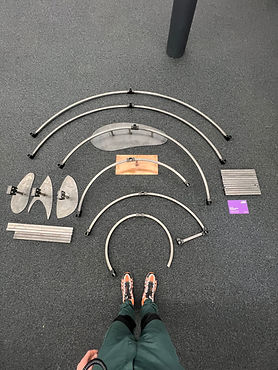


// 0dls vision: The ease of assembling the prototype points toward a larger vision, schools maintaining a stock of modular parts, students organized into small groups rather than isolated at individual desks, and simple, intuitive build guides showing how those shared parts can be reconfigured for any subject or classroom need. I can also imagine individual seating elements detaching entirely, becoming portable, personal, almost locker-like objects students carry between rooms, free to make their own in a way that's expected rather than treated as damage to institutional property.

// future
It's worth imagining what a classroom could feel like if every child in it were moving in sync, freed from the static, immovable furniture that's defined education for generations. A shift that simple, applied consistently, could shape how young minds develop in ways we're only beginning to understand.