


arqr
// key words
augmented reality [AR]
navigational tools
way-finding
quick response code [QR]
mobility
smart city
// premise
In the aftermath of the pandemic, our cohort lost access to a module that, in earlier years, had sent students abroad to work internationally. As the first cohort returning after a stretch of remote learning, that module shifted its focus closer to home, exchanging global scope for local impact. Our cohort partnered with a local city council, tasked with developing creative, forward-thinking solutions to help accelerate the transition toward a more sustainable, smart-city future.
Long before this project, during my military service, I completed advanced navigation training. We were given a map, a compass, and a set of coordinates, memorized before nightfall, then left to navigate entirely without the map, compass only, tracing a route purely from memory and instinct. To measure distance without instruments, I'd sometimes collect a handful of stones, one dropped every sixty-two steps, each representing roughly a hundred meters covered, the remaining stones in hand a quiet, physical countdown to the next change in direction.
That memory resurfaced here, sharpened by contrast. Our biosphere now sits almost entirely inside a technosphere, everything organic layered over with connective technology. Most people navigate the world today through a phone, rarely questioning it, and stones have long since lost their purpose outside contexts like the one I trained in.
Meanwhile, global population continues to climb, driving higher density in cities and placing real strain on how people and goods move through them. With the council's support and our team's shared interest in the problem, we were pointed toward a specific challenge, finding ways to strengthen local economic activity and improve how pedestrians move through a busy, historic stretch of central London.
Ready for Research whenever you have that text.
// research


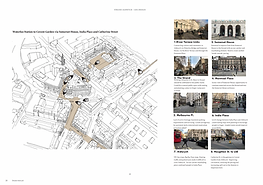

// fieldwork: We began by going directly to the site for firsthand observation, walking the area repeatedly and conducting a series of interviews with the people who actually move through it daily.
// pedestrians: Our walking observations surfaced a consistent pattern, construction created bottlenecks that slowed foot traffic and forced people into awkward, congested movement, and that congestion, paired with ongoing roadwork, left much of the pedestrian experience feeling frustrating rather than pleasant. The makeup and intent of the crowd shifted noticeably by time of day and by block, meaning no single solution would likely fit the entire stretch uniformly.
// transit: Our observations of transit revealed a parallel set of frustrations. Students reported not feeling safe cycling in the area, and pedestrians generally perceived the existing cycle lanes as underused. Bus service felt infrequent and slow enough to discourage reliance on it. One interview captured the underlying tension well, that private transport in the area was effectively reserved for those who could afford it, leaving everyone else to walk, take the bus, or accept the risk of cycling.
// insights: A clear theme emerged, the street functioned more as a corridor meant to move people through quickly than a place designed to be explored or lingered in. Yet the research also suggested that unexpected, delightful discovery wasn't just valuable for tourists, locals and daily commuters responded just as positively when a familiar, routine walk offered something unanticipated. Without prior knowledge or a specific destination in mind, most people would likely never stumble onto the area's genuine points of interest.


// QR technology [qr]
QR code usage had also grown sharply, quadrupling in a single year, driven by its flexibility across everyday transactions and increasing enterprise adoption. Beyond marketing and advertising, where the technology is now common thanks to near-universal smartphone support, QR codes are also widely used to track information through supply chains, demonstrating their reliability as a lightweight, low-cost way to connect a physical object or location to digital information.

//direction
Any intervention we designed would need to live inside the actual context of use and user experience, not exist as an abstract concept layered on top of the street. Drawing on my earlier experience with wearable, code-based identity systems, I was genuinely curious how far we could push a combination of QR technology and AR navigation together. It brought me back to the stones from my
navigation training, markers dropped along a path to measure progress and mark direction. I found myself wondering whether something similar, digital markers guiding people through a dense, disorienting stretch of city, could recreate that same sense of quiet, physical orientation in an entirely different context. The core question became what information or experience we could offer pedestrians that would genuinely improve way-finding and ease movement through a crowded, historic area.
// process
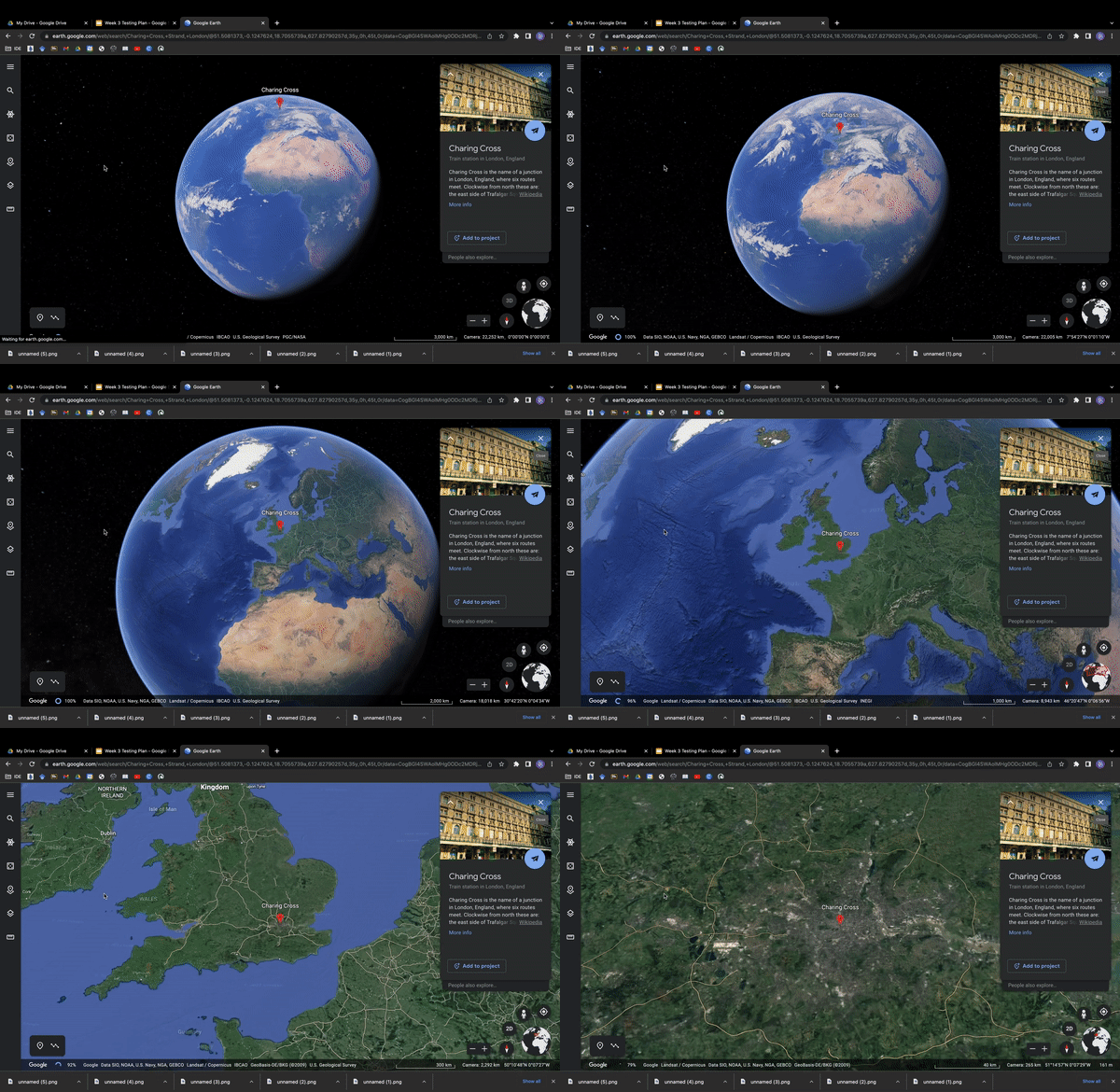


// convergence: The team regrouped after the initial round of interviews and observation, and from that shared research, three common threads of interest emerged, discovery, refuge, and rerouting.
// discovery: This direction focused on guiding people beyond the main thoroughfare toward the local businesses, historical landmarks, and small details they'd otherwise walk straight past. It meant using redirection deliberately, disrupting an otherwise automatic, routine walk in a way that could genuinely improve day-to-day quality of life for the people who pass through the area regularly.
// gamification: A related but distinct idea took shape alongside discovery, treating exploration itself as something closer to play. Rather than simply pointing people toward points of interest, we considered how small incentives, challenges, or rewards could turn the act of noticing your surroundings into something more active and motivating, encouraging people to seek things out rather than passively receive directions.
// refuge: This thread focused on offering pedestrians moments of relief, from negative environmental conditions like noise, pollution, and traffic, from crowding and congestion, and from the weather itself when conditions turned. It also considered how physical space could better support spontaneous social interaction rather than just movement.
// rerouting: The final thread looked at using visual cues to guide people along alternative paths, improving both the clarity and safety of how people moved through the space, and using those same cues to draw people toward areas that currently felt disconnected or overlooked.
// direction
The central question became how to improve discovery, of hidden local detail, historical context, and simple places to pause and stay a while. From there, we moved into sketching and rough prototyping, testing early ideas around pedestrian mobility in the area and asking ourselves how a hybrid digital-physical experience could support both personalized discovery and easier navigation through the neighborhood. We continued layering AR navigation tools into the web-based platform we were building out.
// field testing: Early testing showed genuine interest in AR-based navigation as a way to discover new routes and attractions, particularly since existing mainstream AR navigation tools weren't something people used regularly despite being available. We printed and distributed a series of posters through the area, each carrying a QR code that directed users to the web platform we were developing.
// feedback: The response was strongly positive. People responded well to QR codes specifically as a way of making the technology feel accessible and low-friction rather than intimidating, several remarked that they'd use it and that it felt like a natural next step for how navigation was heading.
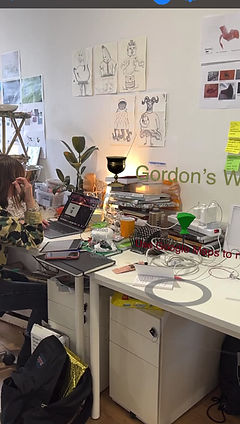

Taken together, this confirmed what the early research had already pointed to, the core problem wasn't a lack of interesting things to find in the area, it was that the environment itself pushed people through and out, rather than inviting them to slow down and actually look.
// outcome

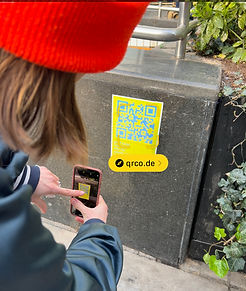
// web: The result was a web-based AR navigation system, arqr, built to generate personalized discovery routes that guide people toward local attractions they'd otherwise miss. The system offered a choice between more scenic paths, faster paths, and routes that wove in points of interest along the way, helping ease pedestrian congestion across the wider area while giving local businesses genuine visibility to tourists passing through, and giving locals more freedom to explore a neighborhood they might otherwise move through on autopilot. The experience itself was designed to feel effortless and genuinely enjoyable to use, not just functional.
User Journey:


01 | underground station: tube reaches station; sees city endorsed ad campaign.
02 | underground station: exits tube; heads up.


03 | underground station: makes their way through the station.
04 | the strand: surfaces overground; city endorsed campaigns wrapped on local buses.

05 | the strand: scans qr poster.

06.a | the strand: arqr mapview.

06 | the strand: user redirected to web/app; inputs destination and selects route from list.

07 | the strand: once route selected AR visibility displayed making real time suggestions throughout their journey
// UX
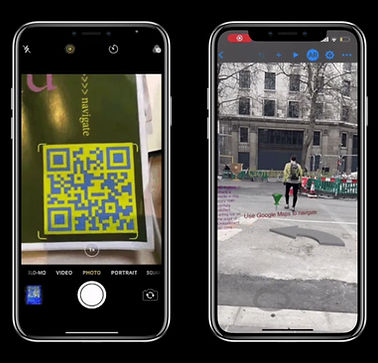
To test the concept, we walked through a real use scenario, a small group of friends deciding, on a pleasant day, to visit a gallery on the Strand. As they move through the connecting train station, they begin noticing a series of visual cues placed along their path, subtle enough not to feel intrusive, but distinct enough to catch attention. By the time they emerge onto the street itself, more cues appear, now paired with small behavioral prompts, an invitation to take the quieter route, or the more scenic one. Curious, they scan a nearby QR code and land on the arqr web experience, no app download required, no friction between noticing the cue and acting on it.

// UI
From there, the AR interface activates, giving the group a clear sense of direction while surfacing a handful of nearby recommendations they'd almost certainly have walked past otherwise, quietly rerouting them through parts of the neighborhood most visitors never discover. Since they're in no particular hurry to reach the gallery, they decide to stop for lunch at one of four suggested spots along the way, opting, in the end, for the scenic route over the fastest one. The interaction feels less like following directions and more like being let in on something.
// arqr
At its core, arqr is a personalized AR experience built around discovery and navigation. Because it runs on QR-triggered web access rather than a dedicated app, there's no download barrier standing between curiosity and use. The platform is designed to surface the local attractions, oddities, and small happenings that sit just outside normal sightlines, letting people engage with a familiar area as though they were experiencing it for the first time.
// reception
Feedback from faculty and industry reviewers was constructive and thorough. One instructor praised the strength of the research and the clarity of the final concept, along with the professionalism of the presentation and the willingness to test rough, "wild" prototypes early, while noting the team could have spent more time validating the core value of the idea before moving into design detail. Another reviewer appreciated the decision to lean on QR codes over AR-app-based navigation, given how little consumer AR is actually used in practice, and praised the real-world testing carried out directly on the Strand, along with an idea to integrate local historical data that could add real value to the council partnership. A third reviewer suggested the team quantify the volume and type of primary research conducted, welcomed the exploration of why AR adoption remains low, and pointed toward related academic work on location-linked audio and soundscape experiences as a promising direction for future development.
// evaluation

im[P]act
// micro: At the individual level, the concept succeeded in its most basic goal, visitors discovered parts of the neighborhood they would otherwise have walked straight past, and the overall pedestrian experience felt noticeably more spontaneous and enjoyable as a result.
// meso: At the level of the street itself, the intended shift was clear, moving the area's identity from a corridor people pass through and out of, toward a place people are drawn to stay in and explore, with the added potential to encourage repeat visits rather than one-off passage.
// macro: At the widest scale, the concept pointed toward genuine economic benefit for local businesses, and toward the possibility of formalized cultural routes through the area becoming a lasting, realized feature rather than a one-time experiment.
// learnings
Real-world testing surfaced some honest, useful friction. QR codes placed along the Strand received only a modest two to four scans each over a full day, a reminder of how difficult it is to interrupt deeply ingrained habits, eyes on a phone, autopilot walking, learned indifference to street-level advertising and signage. It became clear that AR's appeal rests as much on a sense of wonder and novelty as it does on straightforward utility, and that environmental cues can genuinely engage people, but only when the behavioral prompt and its surrounding context are designed with real care. Getting people to notice a cue is one thing, getting them to act on it is a different problem entirely, and one this project only began to solve.


// broader application
Thinking back to the navigation training I completed in the military, and to the navigational experience I've picked up since, in very different contexts around the world, I find myself wondering how a system like this could translate to combat environments. That training moved through defined points along a route, an initial position, a midpoint, an endpoint, each confirmed on arrival by identifying a specific object and documenting it as proof. It raises a real question, could that same structure be gamified for soldiers in training, and how might technology like this eventually function in an active operational setting. The civilian application here is clear and already proven, but I'm genuinely curious where further development could lead, particularly in military or broader municipal contexts beyond the one this project was built for.
// next steps:
[a] A realistic rollout would begin with focused route planning and stakeholder research, scouting physical locations, interviewing locals to shortlist genuinely worthwhile destinations, engaging local business owners directly around route design and potential incentives, and coordinating with the relevant governing bodies to secure the necessary permissions.
[b] From there, a one-month beta would test the concept in the real world, refining the messaging used to draw people in, exploring physical embodiment of the QR touchpoints themselves through sculptural markers, mosaics, or murals rather than plain signage, and expanding both the AR functionality and the "choose your own adventure" style routing that made the early experience feel personal rather than prescriptive.
[c] A further refresh phase would build on that testing, layering in additional local discoveries, exclusive events, fashion collaborations, pop-up access, while evaluating the potential to scale into a full mobile app, integrating the historical data layer being developed by a partner academic institution, and introducing a token or rewards-based incentive system to deepen the gamification thread introduced earlier in the project.