


// from 2d to 3d to 0d
3 6 0d
// key words
artificial intelligence
cyberbullying
OpenAI
GPT-3
natural language processing
children & young people [CYP]
P2M; P2M2P; M2M
machine learning
computer science
cyberdefense
ai tool
ai interactive dialogue
P2M2P [dialogue with ai] interaction
emotional intelligence
human behaviour


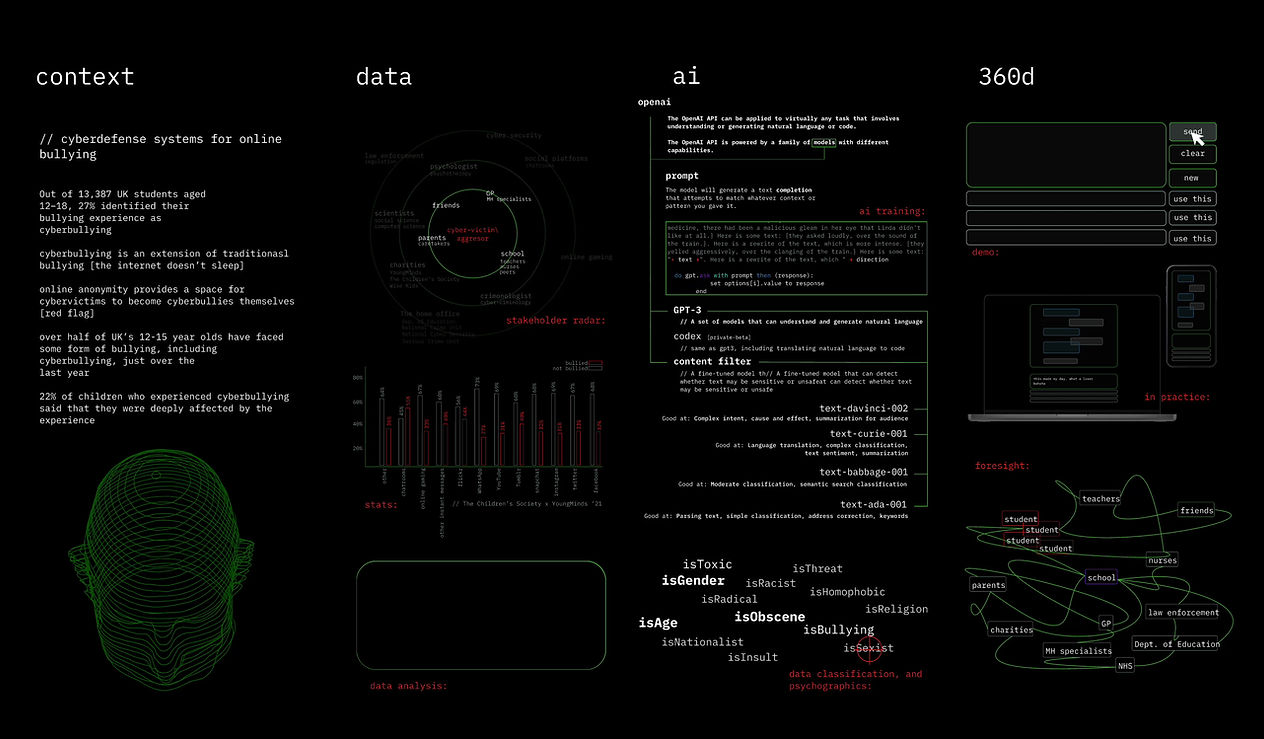
360d was designed using OpenAI's GPT-3 model. Because of chatGPT's release I've decided to remove the contents of this project until I can secure IP. In general I developed 3 prototypes using GPT technology [Before the official chatGPT release] meaning I have been demonstrating these abilities to my colleagues before the hype surrounded this technology.
PLAY VIDEO

PLAY SOUND

Shortly after I arrived to the UK I met a man who’s daughter had been cyberbullyed. At 14, she took her own life. A week later, her mother died of a stroke. In just one week, the man lost both of his girls. Sadly, she isn’t the only one; too many children and young people across the United Kingdom, and the world, are victims of cyberbullying, and very little to nothing is actually being done about it.
Schools have reduced the numbers of nurses in the UK, there is lack of transparency in the communication between schools and gp. The GP’s don’t have the recourses to send the children to the proper spoecialists. The children and primary stakeholders are not educated enough on it, and my competitors aren’t doing enough about it - that’s effective anyway.
Something is broken in the system and the price is being paid with blood. Something has to be done.

So, what we are seeing as an actual cultural paradigm. We have a very powerful tool in the palm of our hands, and the hands of children and young people. Our mobile devices carry our digital identities - a reflection of us , if you will.
Children used to get bullied, went home and had a peace of mind at least. Now they continue to get bullied online, and worse, more cases than not, the veil of the web turns victims of both traditional and cyberbullying into cyberbullies themselves, creating an entire bully culture and spreading the problem - human behaviour which can no longer be tolerated. We need to get ahead of this if our goal is to save lives.
My intervention, unlike my competitors is in the very beginning of the process. Never giving the chance to ever actually send a toxic message, preventing the culture from spreading by putting this tool in the palms of their hands.
i am developing tech from this perspective - developing an intelligent tool that can be so easily integrated into a mobile device.

I’m using technology that is only two years old to create interactive dialogues with
artificial intelligence.
I’m doing this using openAI’s GPT-3 model. Last gateway I demonstrated the machine learning techniques through the open AI playground.
Just last week OpenAI released chatGPT - So before chatGPT was released I demonstrated its abilities in my system. The difference, and what qualifies me as unique over my competitors is the regenerative abilities I’ve built into the system.
I’ve designed and engineered a system unmatched by any competitor currently in the market, putting me at the forefront of innovation in this field.
360d is a response to the inevitable. These new interactions introduces entirely new human behaviour and I am producing immense amounts of momentum by building them.
The linoy 1.0d intelligent keyboard is so easy. Its convenient, and it’s something parents would want their young children to have on their mobile devices - like location services.
The interface protects children from leaving a bad digital footprint and protects children from being bullied in real time.

Where I am now and where I’m headed.
I’ve been designing data prompts and directives for a number of different data classifications
in CYP.
This helps me train 360d for better accuracy - it also enables me the ability to tailor the regenerative outputs - based on the psychographics of the user.
I’ve been training the machine to recognise cyberagression via prompts, and to regenerate alternative text based on the directive. I’m also experimenting with M2M learning to improve interaction quality between human and machine.
The next step is to teach 360d deceptive internet terminology for strengthened defense, because a lot of things being said are spoken in internet jargon.
Looking forward, building the mobile app [then pc] keyboard for direct download
To reach wider audience - expanding by providing other form factors following development
What will a cyber physical device look like?
Where else can the keyboard be implemented?


