


// premise
On New Year's Eve 2020, the Jerusalem cold pressed through three layers and reached something underneath. In that moment, 0d was born — an alter ego, conceived in the cold as a new way of perceiving. ex0d is the biproduct of that conception: the garment, the artifact, the proof that the perception had changed. My understanding of fashion design shifted overnight.
I arrived at Bezalel's fashion department an outsider to the discipline but not to the industry, absorbing its fundamentals fast through practical, high-intensity work. Until then, my creative language had lived in screen-based art. That training became the artillery 0d would draw on, and ex0d the first weapon
forged from it.
sound
ex0d
// key words
exoskin
smartwear
tacticality
agility
IDF
personal security
population
climate
// research

// population
Global population grew from 1 billion in 1800 to 7.9 billion in 2020 — an 87% increase in just 220 years. That trajectory points to a population crisis, and ex0d is built to adapt to what follows: climate change, disease spread, the pressures of a crowded world.
// security
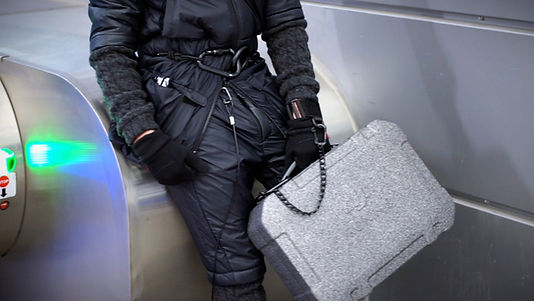
Density and overcrowding correlate with crime. ex0d treats personal security as a design constraint, not an afterthought — borrowing from shiftzurim (combat-style securing of belongings) to protect what the
wearer carries.

// survival
Per the WMO's 2021 State of the Global Climate report, 2015–2021 were the seven warmest years on record. ex0d starts from a simple premise: the body is a vehicle, carrying us from point A to point B, fueled the way we fuel a car. Equipping that vehicle with more intelligent, intuitive systems — communication,
identification — isn't optional anymore; it's adaptation to a world moving too fast to ignore.
// style
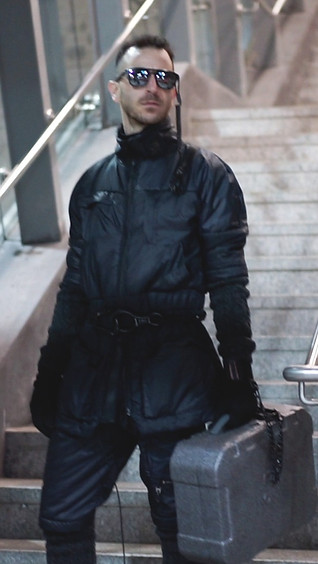
The garment draws on the Israeli paratrooper uniform (yarkit), a symbol of bravery within the IDF and a shorthand for a certain archetype of Israeli masculinity. Built to military-grade specification, it uses layering techniques suited to agility and cold-weather function — a one-piece engineered to read as a traditional
two-piece.

//process
// rough prototyping
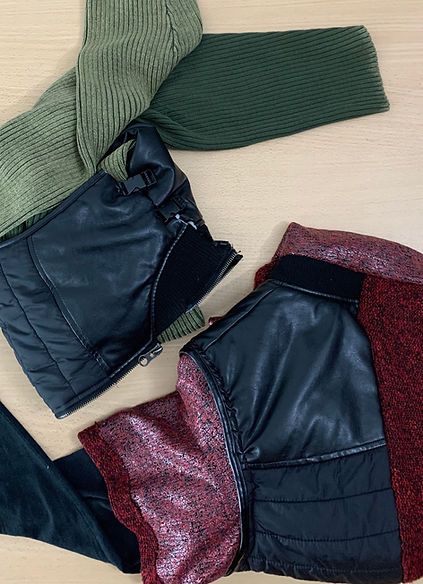
A series of ready-made pieces exploring the tension between wool and nylon, built around multi-functionality and facial protection — a foresight of what COVID-19 would later demand of all of us. I drew early inspiration from Matthew Williams, Virgil Abloh, and Raf Simons, working toward a wardrobe intricate enough to be fashionable while still solving for facial protection. With no formal fashion training yet, I started where I could: essential accessories.




// multidisciplinary
The streetwear course was extra credit, taken in my third year of Bezalel's Screen Based Arts program. I was already developing the artistic language that would eventually give rise to 0d, and this course let me cross departments and combine skillsets without knowing exactly what would come of it.
What emerged was a narrative — the story of 0d's birth — and an ongoing investigation into identity: my own, shaped by the demographic, social, and cultural gaps between growing up in the United States and living in Israel. After New Year's Eve 2020, that inquiry sharpened into climate and population research, aimed at designing attire suited to the conditions ahead. That research became a conviction: if cars are adapting to a changing world, clothing should too. It's our first vehicle — the one we're always wearing — and it needs to communicate with us and our surroundings as much as any other system we depend on.
// technical skills
I came into Bezalel's Fashion Department with no formal design background, and built the technical vocabulary as I went. The garment was constructed around the tension between wool and nylon — pairing the two required working through how each material behaves under military-grade layering, so the piece could hold cold-weather function without sacrificing form.


That layering logic is also what let a single garment read as two: the one-piece was engineered, seam and structure, to visually split into what looks like a traditional 2pc, an articulation problem as much as a design one. None of this came from prior training. What I did have, according to the course instructor, was fashion "in my blood" — and this module was where that got tested and confirmed.


// post-sketch
-
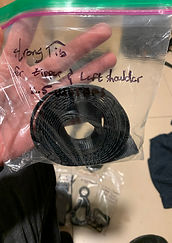
Military-grade fabrics and accessories were sourced to match the intricacy of the ex0d design.
-
Performance and security were stress-tested rather than assumed.
-
A professional was brought on to measure and assemble the piece — working with her shaped my collective design approach, one built on giving artistic freedom room inside a technical process.
// outcome

// elegance
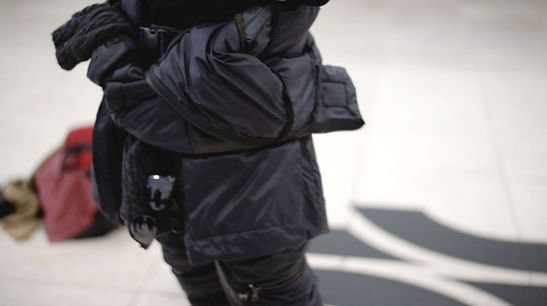
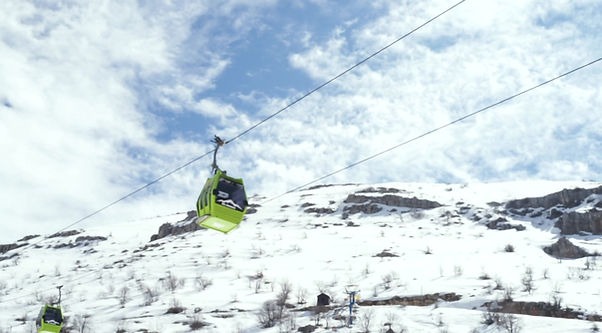
ex0d is built from the highest-grade fabric available locally — a choice with both sustainable and economical upside — and shaped to echo the formal IDF paratrooper uniform. It's triple-layered (double, in some configurations) for light-to-medium winter conditions, and it's been proven on the mountain: tested on Mount Hermon. The materials — nylon, rayon, wool, metal — were chosen to hold up there.
// tacti-functionality
The belt uses aleph aleph, a rope-tying technique that's as stylish as it is practical — and given the grade of material, it doubles as a survival tool if the situation calls for it. Metal wiring runs through the garment via locking carabiners, giving the wearer multiple points to secure personal belongings directly to the body.


// intuitivity
Every pocket on ex0d has a designated purpose, built around what the wearer actually needs to carry. High-grade elastic fabric keeps everything fixed in place — nothing loose, nothing in the way of movement. Over time, that structure becomes muscle memory: the wearer starts interacting with their own belongings without thinking, and daily efficiency follows.
// comfortability
The comfort of ex0d isn't just physical — it's psychological. Knowing your belongings are secured to you changes how freely you move through a day. Scaled up to the population level, that's the real bet: the wearer of the future needs a solution for theft and loss built into what they wear, not bolted on after the fact.

sound
// multidisciplinary
The identity work done in Studio Gimel — my third-year journal studio in Screen Based Arts — and the identity work done designing ex0d converged into a single video piece: TSS (The Smart Survive), the film that first revealed the character who would become 0d. Wearing the garment, that character travels from the northernmost to southernmost reaches of a dystopian Israel, moving through abstractions society disguises from itself. Shot partly during the first COVID-19 lockdown, the film carries that eeriness in its atmosphere — an exploration of internal versus external, isolation and desolation, time and place, and identity running under all of it.
sound

TSS was later selected and projected on the ZAZ billboard in Times Square, New York — a moment captured, unprompted, by a friend who happened to notice it and thought to document it. Since it screened without sound, I re-cut the clip with its original audio for the record. It marked something for me beyond the film itself: a new intersection of video and fashion, and a deeper commitment to visual storytelling as a creative language.
sound
// evaluation


// adaptability
Over the next several decades, global population is projected to keep climbing — and the faster it grows, the faster our solutions need to adapt. Right now, few are seriously confronting the need for intelligent wearables. I see ex0d as a first step toward that future: with more time and resources, it has the potential to become the first true smartsuit — the Macintosh of fashion, built for the everyday wearer rather than a niche.

// [para]military
I envision extending this into a uniform purpose-built for [para]military personnel — adaptive to terrain, responsive to the person wearing it. Active personnel need to be better equipped than whatever they're up against, human or environmental. ex0d attends to details mass production tends to skip, and I see real room in this field for that level
of consideration.

sound
// [bio]diversity
Human activity has visibly degraded the planet — the water and air available to us today aren't what they were. It's easy to think of ourselves as separate from that context, but we're not; our space here is finite, and the population drawing on it keeps growing. We're explorers by nature, and I see a clear line from the ex0d prototype to future smartsuits built for space exploration, where adaptability isn't optional — it's survival.