


This video may contain content not authorised for use by its owner. The contents have been edited, and are used for academic reasons alone. Edited by 0d for bi0simulation [22].
-play sounds for best results.
bi0simula-tion
// key words
diel vertical migration
carbon capture
deep sea
ocean relay
live data
immersive simulation
interactive education
sound
// premise
The 2022 Grand Challenge at the Royal College of Art's School of Design brought together more than 350 multidisciplinary graduate students to investigate a single, urgent planetary problem, this time centered on the world's oceans. The challenge asked participants to identify opportunities for strategic, systems-level design innovation capable of shifting culture, values, and attitudes toward the environment. Framed as a new economic model for the oceans, the work spanned continents and themes, environmental impact, the erosion of marine ecosystems, habitat loss, ocean plastics, emerging blue economies, and long-term environmental sustainability.
My relationship to the ocean runs deeper than this project. My grandfather, fluent in eight languages, served as a naval officer, trained during a period of British military presence in Egypt, around the time a treaty was signed between the two nations in the 1930s. Before he passed, his final request was to be buried facing the sea. Today, his tomb rests beside my grandmother's, on a hill overlooking the Mediterranean in Haifa, the same waters he spent years of his life devoted to.
I have only fragments of memory of him, but among them is his love for the ocean, and the respect he held for it. He taught me about its vastness and its danger, the importance of what lives beneath its surface, and the cultures shaped by the people living along its distant shores. He was, in his own way, my first real example of what it meant to explore. Much has changed in the decades since his service, but I am still, in some sense, my grandfather's grandson. My understanding of exploration looks different than his did, but I consider myself an explorer in my own right, one seeking knowledge and insight in service of leaving the world a little better than I found it.
We've grown disconnected from our oceans. Entire worlds exist beneath the surface we rarely think about, and we've too often taken them for granted, causing harm below while endangering life above in return. No life should be taken carelessly. Engaging deeply with the ocean, even metaphorically, reconnected me with everything living beneath its surface. There is intelligence down there, and I hold onto the idea that we might one day work in genuine harmony with marine life toward something we both need. If the life above the surface understands the scale of what's at stake, the life beneath must, in its own way, understand it too. I imagine a future where science helps us collaborate with marine life more directly than we do now, in ways that go beyond observation and extraction. In some way, that vision feels like an extension of my grandfather's legacy, carried forward through very different means.
// learning objectives
LO1] Translate large scale systemic issues into an
actionable design brief.
LO2] Use and effectively experience interdisciplinary design
methods to address the brief.
LO3] Use design research to develop a systemic
proposition towards proof of concept.
LO4] Evidence to develop and prove concept(s), through
physical, digital, or appropriate means.
// research

The initial catalyst for our investigation was sound pollution caused by human
activity and its impact on aquatic environments. This introduced us to the topic
of migration. Together, with our personal interests in data collection and
sensorial immersive experience. We considered design propositions that attempted
to interconnect these areas through complex and speculative ideas.
// pollution
Ocean noise pollution stems largely from human activity, commercial shipping, seismic surveys, oil exploration, and military sonar among the main contributors. That noise poses a serious, often underappreciated threat to marine life, and its impact extends far beyond the whales and dolphins most commonly associated with ocean sound, affecting a much broader range of species that rely on acoustic signaling to navigate, feed, and communicate.
// dvm
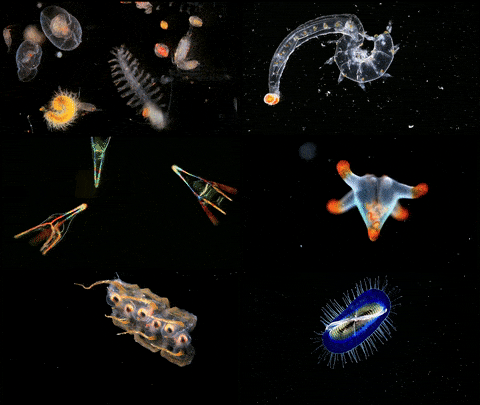
Diel vertical migration. Every day, billions of small marine organisms, largely zooplankton, migrate vertically through the ocean on a massive scale, a phenomenon scientists call diel vertical migration. Swarms rise toward the surface after dusk and retreat back into the depths before dawn, a rhythm most people have never heard of despite its outsized role in sustaining a balanced ocean ecosystem. This nightly migration drives an essential transfer of nutrients and plays a critical part in the planet's carbon cycle, when marine organisms die, the carbon they carry gets sequestered in their remains on the ocean floor. The scale involved is significant, a single sinking whale carcass alone can sequester more than 33 tonnes of CO2.
// blue data
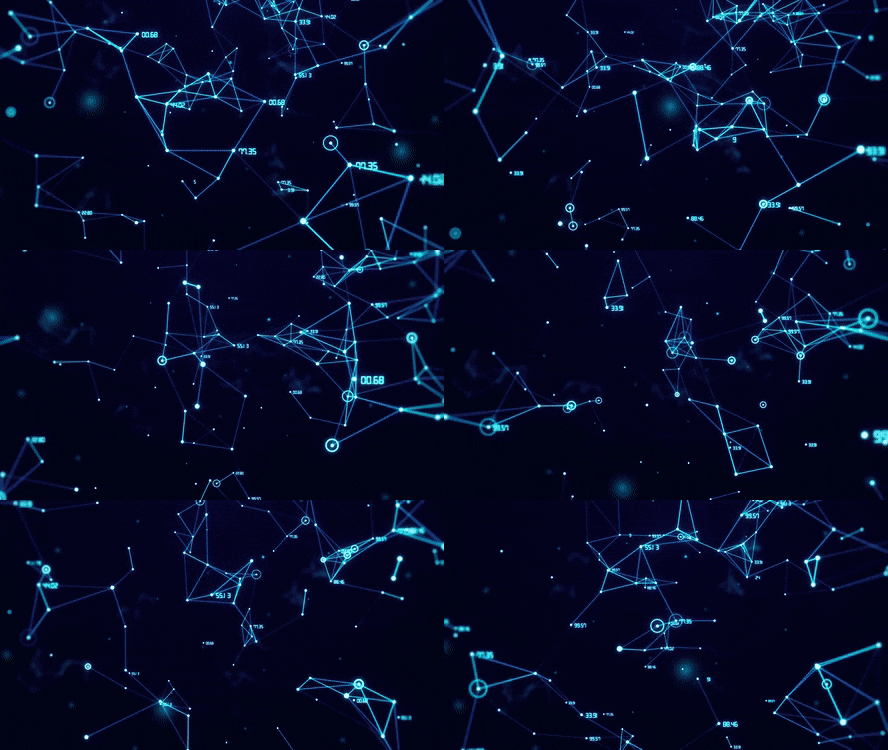
Ocean observation is foundational to ocean science, and the field is entering a genuine big-data era as sensor technology and observation infrastructure continue to advance. Networks of ocean observatories now carry sensors capable of sampling the ocean across meaningful spans of time and space, generating data that supports both fundamental research and applied, real-world questions. Given the sheer volume, variety, and sustained nature of this data, it qualifies as a distinct category of big data in its own right, one that traditional, data-centric infrastructure isn't fully equipped to handle as new challenges continue to emerge in ocean science.
// deep sea mining
Mining activity on the ocean floor causes direct, often irreversible damage, destroying natural seafloor formations and the species that depend on them, compacting sediment, and generating plumes that disrupt aquatic life well beyond the immediate mining site. Secondary effects extend further still, underwater noise, electromagnetic disruption, interference with larval development, and changes to local water chemistry and flow.


// hydrothermal vents
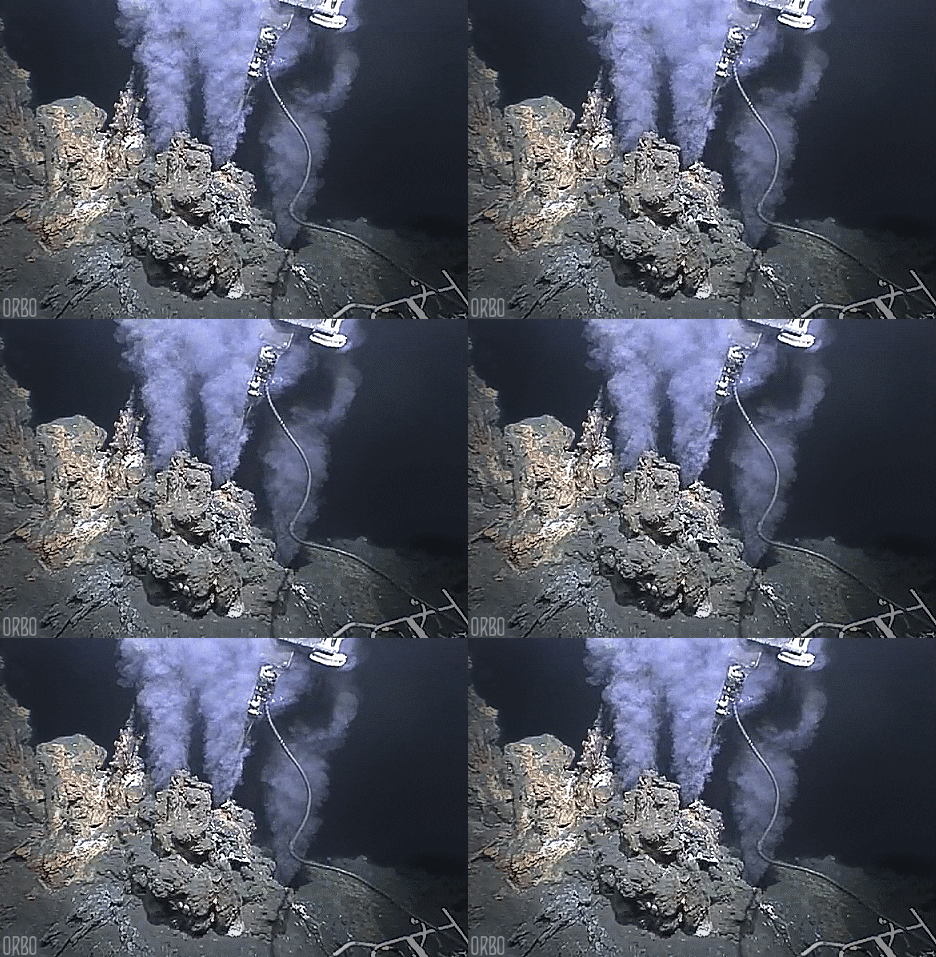
Hydrothermal vents function as natural plumbing systems, channeling heat and chemical compounds up from the Earth's interior and playing a meaningful role in regulating global ocean chemistry. In that same process, they accumulate substantial deposits of valuable minerals on the seafloor, making them a point of growing scientific and economic interest, and growing environmental concern.
// bioacoustics
Beyond noise as a pollutant, marine species rely on sound as a primary means of navigation, communication, and hunting, whales, dolphins, and countless other species included. Rising ambient ocean noise doesn't just disturb marine life, it actively degrades the communication systems entire ecosystems depend on, adding a layer of urgency to the broader pollution research.
// blue economy
A blue economy refers to the sustainable use of ocean resources for economic growth, improved livelihoods, and job creation, while actively preserving the health of ocean ecosystems. As pressure on ocean resources intensifies globally, the blue economy framework offers a useful counterpoint to extractive models like deep sea mining, one grounded in long-term coexistence rather than short-term extraction.
// process

// live data
The Royal College of Art was given access to live oceanic data collected from a research vessel, and our team's primary focus settled on sound pollution within that dataset. That focus quickly revealed a shared interest across the team in live data itself, how it's collected, translated, and transmitted from deep ocean environments back to something usable. Early on, we explored the concept of remote data relay from the deep ocean, alongside the potential role of autonomous underwater vehicles in deep-sea exploration and data collection.
// discovery
As the research deepened, we came across diel vertical migration and the broader interconnected rhythms of ocean ecosystems, what we'd come to understand as a kind of biological pump, a natural system for exchanging vital nutrients throughout the ocean. This felt significant. Almost none of our peers or competing teams in the challenge had encountered diel vertical migration before, and our team was recognized for bringing genuine originality and creative thinking to the space. The data itself opened up a world my grandfather could never have imagined access to, and much like my experience with 0dls, I felt that same pull again, a real urge to contribute something meaningful to the planet, rooted in coexistence with marine life rather than domination over it.

// tension
That ambition comes with real difficulty, given how extensively human activity has already reshaped marine habitats. Some of the life in the deep ocean has been evolving since long before humans existed, and our presence continues to disrupt those habitats, threatening species we're still working to understand, some of which remain entirely undiscovered.
// direction
Our research made one thing clear, the data exists, but as a relatively young field, it remains difficult to access and is far from being used to its full potential. That gap became the starting point for our concept, imagining scenarios where users could interact directly with ocean data for educational and artistic purposes. From that, we proposed a simulation-based design we called bi0simulation.
// presentation
The concept was brought to life through a narrated visual presentation delivered by the team, paired with a video that helped translate the more abstract, speculative elements of the proposal into something tangible and easier to grasp.

// outcome

// concept
The proposal centered on a single guiding question, what if immersive simulation could unlock the full value of this data, bringing something as invisible and remote as diel vertical migration into a space people could actually stand inside and experience. Rather than presenting ocean data as charts or abstract numbers, bi0simulation reimagined it as a spatial, physical experience grounded in real environmental patterns.
// environmental layer
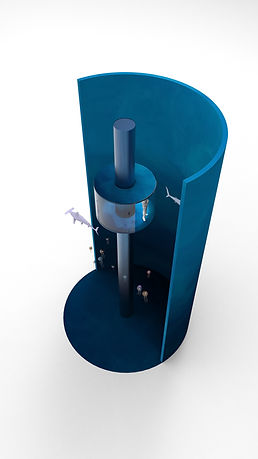
The outermost layer of the system functioned as an environmental map, governing the overall atmosphere of the simulated space. This layer set the tone and conditions for everything happening within it, establishing the simulated ocean environment as a living, responsive backdrop rather than a static setting.


// stereoscopic space
Within that environment, a stereoscopic spatial layer was programmed to shift dynamically, designed to mirror the actual rhythm and conditions of the migratory journey itself, in this case, the life cycle of plankton moving through the water column. Rather than a fixed, repeatable sequence, the space was built to feel alive and slightly unpredictable, echoing the natural variability of the phenomenon it represented.
// data navigation
At the core of the experience sat a central data navigation interface, allowing an operator to move through the simulation along a three-dimensional vertical axis. Within that interface, real data inputs, distance and velocity among them, could be applied directly to the observation of marine activity, transforming raw measurement into something perceptual and visual. This gave users the ability to observe migratory movement from angles and perspectives that raw data alone could never offer.
// spatial value
Taken together, the spatial design added a dimension of understanding that conventional two-dimensional data or standard three-dimensional visualization simply couldn't reach on their own. By allowing users to move through the data rather than simply view it, biosimulation proposed a genuinely new way of interpreting and relating to ocean phenomena most people will never witness directly.

// evaluation
// phased rollout
The proposal envisions a deliberately staged rollout rather than an immediate, broad deployment. Spatial bi0simulations would first be introduced within research centers, giving data analysts a controlled environment to explore and validate the format before it reaches a wider audience. Only once the approach is established, and the underlying data is being studied in its most realistic, reliable form, would the concept extend outward.
// public deployment
From that research foundation, we imagine bi0simulations eventually finding a home in museums, schools, and institutions like naval or maritime organizations, reaching everyday citizens rather than remaining confined to specialists. At that stage, the technology shifts from a research tool into a form of immersive education, one capable of drawing a direct, felt connection between life above the ocean's surface and the vast, largely invisible life beneath it.
// new pathways
The opportunities this opens extend well beyond ocean science itself. We see real potential for deep sea and space training programs built on the same underlying simulation technology, creating entirely new career paths in exploration and data analysis, fields that barely exist yet but will likely grow substantially as remote and extreme environments become more central to research and industry alike.

// scalability
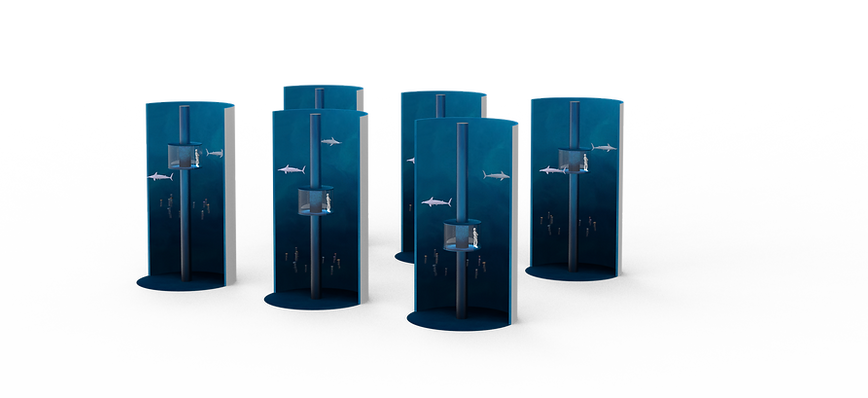
Diel vertical migration is only a single case study within a much larger possibility space. The deeper ambition behind biosimulation is the underlying method itself, the idea that any sufficiently rich dataset could be translated into an immersive, spatial experience. Applied broadly, this raises a genuinely bigger question, what would it mean to fundamentally change how we interpret and interact with data across every field that produces it, not only oceanography.

// environment
We envision the physical home for these biosimulation pods as something intentionally underground, an environment researchers descend into rather than simply walk through. That framing is deliberate, entering the depths of the earth to uncover and engage with data drawn from the depths of the ocean, a symbolic and physical mirroring of the very phenomenon the simulation exists to reveal.